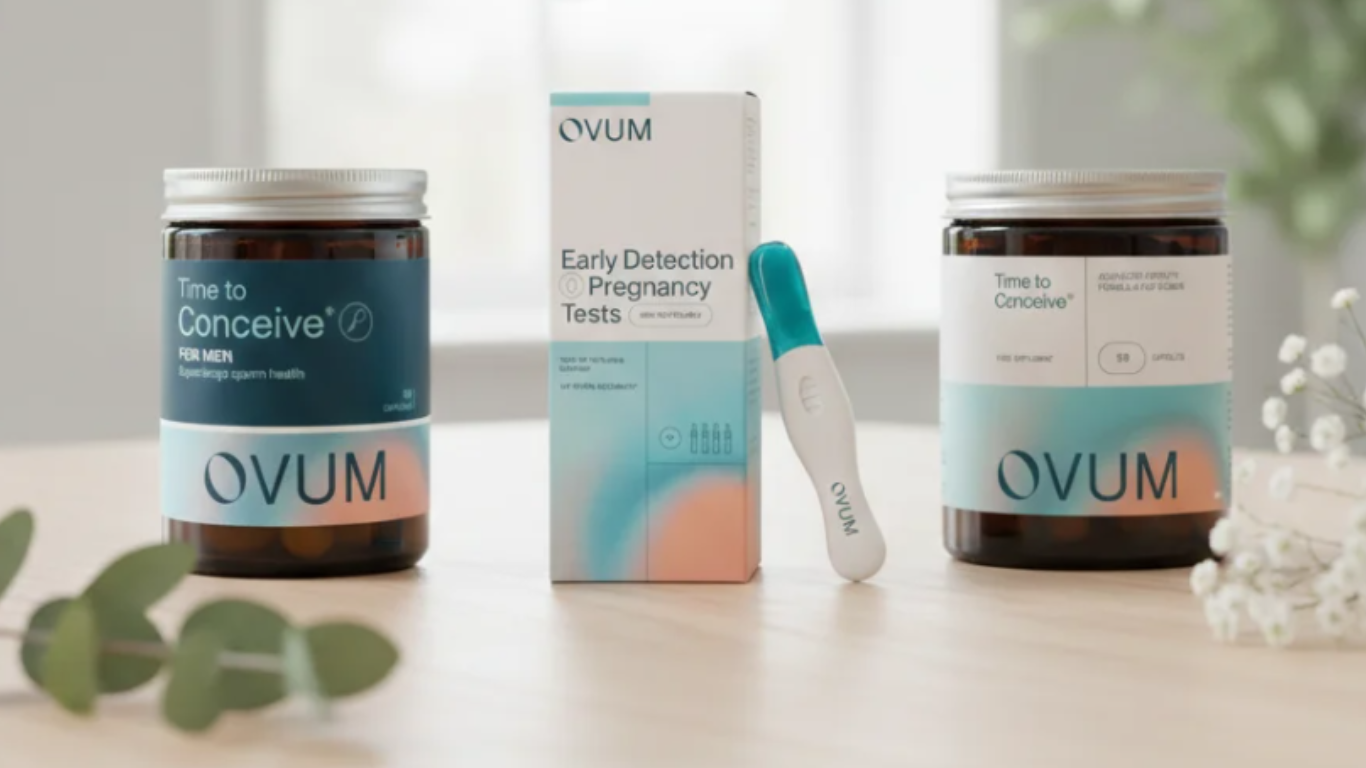
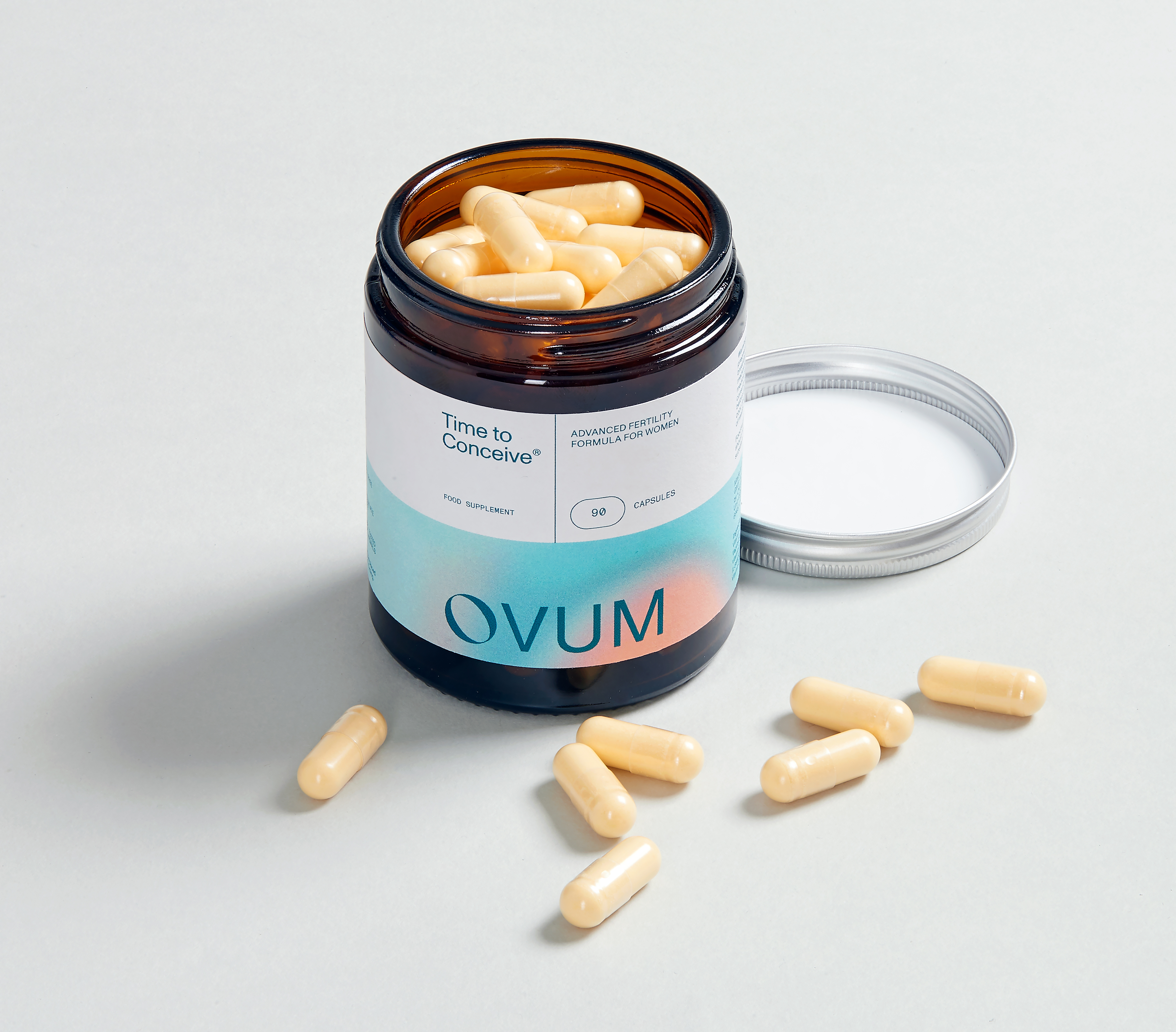
Why We Use OVUM Time to Conceive: A Preconception Supplement Actually Built for Women Like Our Clients
May 29, 2026Walk into any pharmacy or scroll through any fertility forum and you'll find dozens of preconception supplements. Most of them are variations on the same theme: a generic prenatal multivitamin with standard doses of standard ingredients, dressed up in fertility-specific packaging.
OVUM Time to Conceive is not that.
It was developed specifically for women navigating complex fertility journeys — PCOS/PMOS, recurrent miscarriage, low ovarian reserve, irregular cycles, poor IVF response. In other words: exactly the women we work with.
Here's why it's the only women's preconception supplement we recommend — and why the detail of what's in it matters more than the marketing around it.
The three ways most fertility supplements fail
Before explaining what makes OVUM different, it's worth understanding why most supplements don't work as well as they should.
Wrong form. Many nutrients have multiple available forms — and the form determines how well the body can actually use it. Folic acid is the most common example. It appears in almost every preconception supplement on the market. But a significant proportion of women cannot efficiently convert synthetic folic acid into the active form the body requires. For women with PCOS/PMOS, recurrent miscarriage, or an MTHFR genetic variant, this isn't a minor detail — it potentially means the supplement is doing very little for the most critical nutrient in preconception care.
Wrong dose. A supplement can list an ingredient on the label at a dose too low to have any measurable physiological effect. It's technically present. It isn't actually working. This is particularly common with CoQ10, where cheaper supplements routinely include doses far below those shown in the research to be effective.
Poor bioavailability. Even at the right dose, if the delivery format isn't optimised for absorption, the nutrient may not reach the tissue where it's needed. This is especially relevant for fat-soluble nutrients like CoQ10, vitamin D, and vitamin E.
OVUM's position is unambiguous: no fillers, no bulking agents, no shortcuts. Everything included is in its most bioavailable form and at doses backed by scientific evidence as being the optimal dose demonstrated to have the greatest benefit on egg health.¹
That standard is what we hold our supplement recommendations to.
OVUM ingredients — and why each one matters
Methylfolate (L-5-MTHF) — not folic acid
This is the single most important differentiator for our client group, and the reason OVUM sits above most competitors regardless of price.
Methylfolate is the active form of folic acid. If methylfolate is lacking — due to the MTHFR mutation and the inability to convert folic acid efficiently — homocysteine can build up to dangerous levels. Researchers have found a significant association between elevated homocysteine levels and recurrent miscarriage. A randomised controlled trial published in PLoS One confirmed that methylfolate supplementation is more effective than folic acid in women with MTHFR variants and a history of recurrent pregnancy loss.²
Women with PCOS/PMOS have higher homocysteine levels and a greater frequency of MTHFR variants compared to controls — particularly women affected by recurrent miscarriage. In these cases, L-methylfolate is recommended instead of folic acid, as it bypasses the MTHFR pathway and delivers the active form the body can actually use.³
For a woman with PCOS/PMOS, recurrent miscarriage, or unknown MTHFR status, a supplement containing methylfolate rather than folic acid is not a premium upgrade. It's clinically appropriate care.
MicroActive® CoQ10 — patented, proven bioavailability
CoQ10 is one of the most extensively researched nutrients in reproductive medicine. Review findings provide promising evidence that CoQ10 directly modulates age-associated cellular challenges — specifically ovarian ageing and poor oocyte quality — by enhancing mitochondrial function. Clinical studies demonstrate that CoQ10 supplementation enhances ovarian function, increases the number of eggs retrieved, and improves embryo quality, particularly in women with diminished ovarian reserve or older age. Its potential in addressing conditions such as PCOS has also been specifically explored in the research.⁴
The challenge is absorption. Not all CoQ10 is absorbed equally. OVUM uses a patented form called MicroActive® CoQ10, which has been shown to have 3.7 times higher bioavailability than standard CoQ10 formulations — meaning that 200mg of this form is as effective as 600mg of a standard preparation.⁵
A randomised controlled trial published in Reproductive Biology and Endocrinology found that women pretreated with CoQ10 before an IVF cycle had improved ovarian response, higher fertilisation rates, and better-quality embryos compared to controls. CoQ10 is naturally found in ovarian follicles, where it supports mitochondrial energy production and protects against oxidative damage to egg cell DNA.⁶
For women over 35 — where mitochondrial function in egg cells is a primary clinical concern — this is not an optional extra. It is foundational.
N-Acetyl L-Cysteine (NAC)
NAC is a potent antioxidant precursor to glutathione — the body's primary cellular antioxidant. Oxidative stress damages egg cell DNA, reduces fertilisation potential, and increases the risk of chromosomal abnormalities. NAC directly counters this. It has also been specifically studied in PCOS for its role in supporting ovulation and insulin sensitivity — making it particularly relevant for women with PCOS/PMOS.
Alpha Lipoic Acid
Another antioxidant working alongside NAC to neutralise free radicals and protect egg cell integrity. Alpha lipoic acid is both fat and water soluble — meaning it can protect cell membranes and the cellular environment simultaneously — which makes it unusually versatile as an antioxidant in reproductive tissue.
Zinc Picolinate
Zinc is essential for ovulation, egg maturation, and early embryo development. OVUM uses zinc picolinate — one of the most bioavailable forms of zinc — rather than the cheaper zinc oxide found in most generic supplements.
Selenium (L-Selenomethionine)
Selenium deficiency is associated with thyroid dysfunction, miscarriage risk, and poor embryo development. L-selenomethionine is the organic form — significantly more bioavailable than inorganic selenium compounds.
Vitamin D3 (Cholecalciferol)
Vitamin D deficiency is prevalent in the UK and directly affects fertility, immune function, and early pregnancy outcomes. Cholecalciferol is the form that most effectively raises serum vitamin D levels.
Vitamin B12 (Methylcobalamin)
The active, bioavailable form of B12 — not the cheaper cyanocobalamin found in most generic supplements. Essential for DNA synthesis, homocysteine metabolism, and neurological development in early embryogenesis.
Vitamins B6, C, and E
All present in bioavailable forms and at evidence-backed doses, supporting hormonal regulation, antioxidant protection, and immune function throughout the preconception period.
A note on the ingredients list
A question we're sometimes asked: what are the "other ingredients"?
OVUM uses a small amount of rice flour which is used to fill the capsule — necessary to aid production and reduce the potential for nutrient oxidisation. Beyond this, the formula contains no colourants, preservatives, additives, or fillers of any kind. It is free from gluten, dairy, soy, wheat, nuts, artificial colours, flavours, added sugar, and GMOs. All OVUM products are also free from BPA and phthalates.¹
For women whose hormonal and immune systems are already under stress, the last thing a fertility supplement should be adding is unnecessary chemical load. OVUM doesn't.
The product is also made in the UK, reviewed annually by the clinical team to ensure it reflects the latest evidence in reproductive health, and recommended by fertility doctors across multiple UK IVF clinics.

Why this is specifically right for our clients
Our clients are predominantly women aged 35+ navigating PCOS/PMOS, unexplained infertility, recurrent miscarriage, recurrent implantation failure, or secondary infertility. OVUM Time to Conceive is formulated for exactly this group — those facing fertility challenges such as PCOS, low ovarian reserve, and irregular cycles, and those who have suffered pregnancy loss, as it aims to counter DNA abnormalities linked to early pregnancy loss.
The methylfolate rather than folic acid speaks directly to the PCOS/PMOS and recurrent miscarriage populations. The MicroActive® CoQ10 speaks directly to women over 35 and those with diminished ovarian reserve. The antioxidant complex — NAC, alpha lipoic acid, vitamin C and E — addresses the oxidative stress that underpins poor egg quality across all of these groups.
This is not a supplement we recommend because it exists. It's a supplement we recommend because every ingredient maps directly onto the physiological patterns we see in our clients.
How we use it at Fertility-Fit
We assess first.
When you are supported by Fertility-Fit, OVUM Time to Conceive is introduced at a point in your plan timed to cover the full 90-day egg maturation cycle before your target conception window. Eggs take 90 days to mature — which means the nutritional environment you're in right now is directly shaping the quality of the eggs that will be available in three months.
For independent clients, we recommend starting at least 90 days before you plan to begin trying — and ideally alongside a full review of your existing test results and supplement picture, so we know what else may need addressing.
Who this is for:
- Women with PCOS or PMOS — the methylfolate and NAC make this formulation particularly clinically appropriate
- Women with recurrent miscarriage or recurrent implantation failure
- Women over 35 where egg quality and mitochondrial function are primary concerns
- Anyone preparing for IVF who wants to optimise egg quality before retrieval
- Women with low ovarian reserve or poor response in previous IVF cycles
- Anyone with a known or suspected MTHFR variant
Who this isn't for:
- Anyone with a known allergy to any listed ingredient — check the full ingredient list before purchase
- Women who are already pregnant — a pregnancy-specific formula is more appropriate once you have a positive test; speak to your midwife
The bottom line
Most fertility supplements are generic. OVUM Time to Conceive is specific — in its ingredient selection, its forms, its doses, and the clinical population it was designed for.
The women we work with deserve supplements that match the complexity of their situation. This one does.
Supplements are never the plan. They're the support.
Want to understand whether OVUM Time to Conceive belongs in your fertility plan? Book your Fertility Strategy Call and we'll look at your full picture first — before you spend a penny on anything.

References
- OVUM. "Frequently Asked Questions." startwithovum.com/pages/faq. Accessed 2026.
- Hekmatdoost A, Vahid F, Yari Z, Sadeghi M, Eini-Zinab H, Lakpour N, Arefi S. "Methyltetrahydrofolate vs Folic Acid Supplementation in Idiopathic Recurrent Miscarriage with Respect to Methylenetetrahydrofolate Reductase C677T and A1298C Polymorphisms: A Randomized Controlled Trial." PLoS One 10, no. 12 (2015): e0143569. doi: 10.1371/journal.pone.0143569. PMC: 4668025.
-
Asanidze, E., Tsetskhladze, Z.R., Jenaro Kristesashvili, Pirtskhalava, M., Manana Urjumelashvili, Shorena Tchiokadze, Malkhaz Vakhania, Nino Parunashvili and Aleksandre Asanidze (2025). The Relationship between Homocysteine Levels,. PubMed, [online] 19(1), pp.50–57. doi:https://doi.org/10.22074/ijfs.2024.2008377.1504.
- Jiang, Y., Han, Y., Qiao, P. and Ren, F. (2025). Exploring the protective effects of coenzyme Q10 on female fertility. Frontiers in Cell and Developmental Biology, 13. doi:https://doi.org/10.3389/fcell.2025.1633166
-
Akarsu, S., Gode, F., Isik, A. Z., Dikmen, Z. G., & Tekindal, M. A. (2017). The association between coenzyme Q10 concentrations in follicular fluid with embryo morphokinetics and pregnancy rate in assisted reproductive techniques. Journal of assisted reproduction and genetics, 34(5), 599-605
- Xu Y, Nisenblat V, Lu C, et al. "Pretreatment with coenzyme Q10 improves ovarian response and embryo quality in low-prognosis young women with decreased ovarian reserve: a randomized controlled trial." Reproductive Biology and Endocrinology 16, no. 1 (2018): 29. doi: 10.1186/s12958-018-0343-0. PMID: 29587861.
- OVUM. "Time to Conceive — Product Information." startwithovum.com/products/pre-conception-and-ovulation-support. Accessed 2026.
Don't miss a beat!
New moves, motivation, and classes delivered to your inbox.
We hate SPAM. We will never sell your information, for any reason.